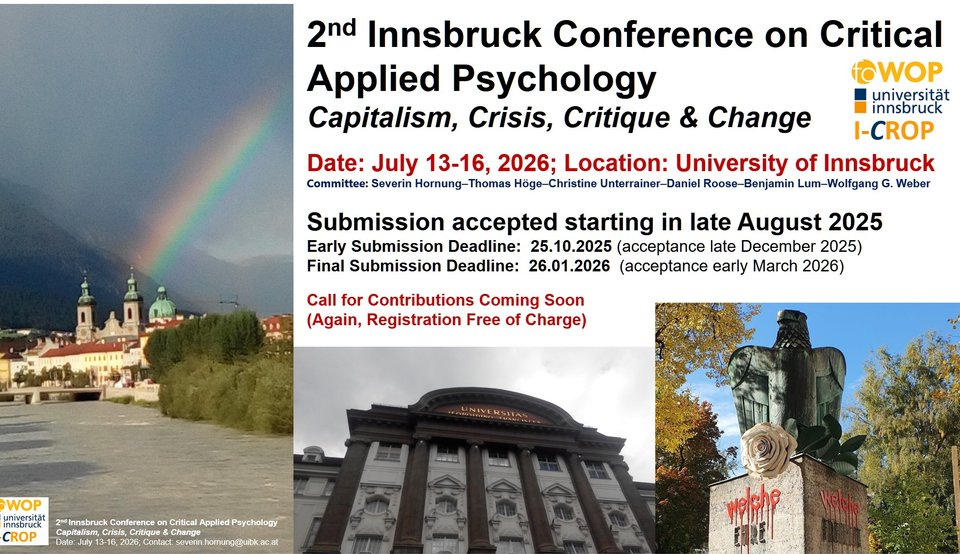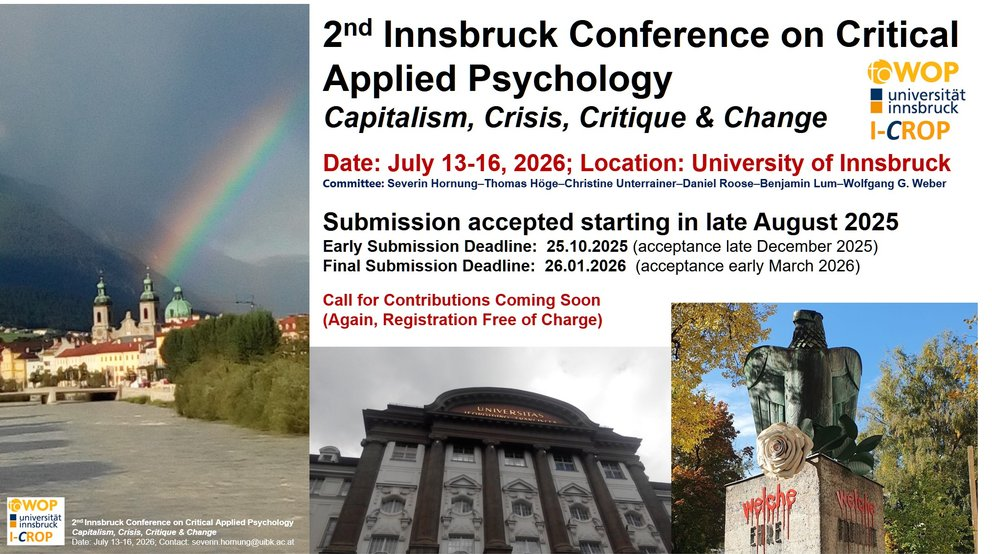

2nd Innsbruck Conference on Critical Applied Psychology
December 11, 2025
What’s Next: Management Scholarship in Times of Societal Dysfunction, Disintegration, and Authoritarianism
The world is in crisis. Climate change remains unresolved. Authoritarianism is on the rise. Freedom of speech and academic freedom are under attack. These are all symptoms of a deeper societal dysfunctioning that is currently escalating, and that seems to have no end in sight. However, it is unclear how academics can effectively respond to these worrying developments. Business schools and management scholarship, in particular, have often remained silent or confined their engagement to safe, technical debates detached from broader political and moral questions. In response to complex and polarizing developments, many institutions, including some of the world’s most prestigious universities and business schools, have adopted “institutional neutrality” policies, announcing that they will no longer comment on public matters deemed unrelated to their academic mission. So, if academics remain (or are forced to remain) silent during what responsibilities do we carry in times of democratic erosion, ecological breakdown, and institutional decay? And how might we act differently?
During this event, we will present our ongoing work on these topics and provide ample space for interactive discussion on these matters. The event also includes a workshop at the end, in which we discuss ways to address our own roles as academics in addressing our contemporary societal dysfunction. Andy Brookes will present his work on (un-)sustainability and societal dysfunction, and Matthijs Bal, Mehmet A. Orhan, and Yvonne van Rossenberg will present their work on the death of academia and the publication system.
We invite you warmly to our event taking place on 28 April 2026 at Radboud University Nijmegen (room to be announced).
Date: 28 April 2026, 11:00-15:00, including lunch.
Venue: Radboud University, Nijmegen School of Management (Room TBDs)
Participation is free, but please register before 20 April 2026 via https://forms.gle/wsY2TptkJsvwXAiM8 (so we can arrange refreshments and lunch).
Preliminary Program
11:00-11:45: Andy Brookes (University of Lincoln): Tackling climate change and other crises: Learning from 40 years of failure
11:45-12:30: Matthijs Bal (University of Lincoln), Mehmet A. Orhan (EM Normandie), and Yvonne van Rossenberg (Radboud University): Reproduction of form in management and organization research: Why and how compulsively repetitive publishing kills academia
12-30-13:30: Lunch
13:30-15:00: Workshop on what management academics can do in response to societal dysfunction
Organized by:
Yvonne van Rossenberg (Radboud University Nijmegen)
Mehmet A. Orhan (EM Normandie Business School)
Andy Brookes (University of Lincoln)
Matthijs Bal (University of Lincoln)
This event is a shared initiative in collaboration with the research lab Sustainable Academia (Radboud University) and the Future of Work and Organizational Psychology.
ABSTRACTS
Tackling climate change and other crises: Learning from 40 years of failure
Andy Brookes
The lack of substantive progress over the last 40 years in dealing with climate change and other global challenges means that many of these problems have now turned into crises, dangerous tipping points where human and natural systems start to break down and collapse. This failure to bring about necessary transformative change demonstrates the inadequacy of strategies underpinned by the mainstream sustainability discourse. In this presentation Andy argues that socio-environmental harms are the consequences of enduring societal dysfunction. He analyses this state of dysfunction by drawing on cross-disciplinary concepts such as hypernormalisation, complex systems, planetary health, social institutions, values, and power. This framing enables the identification of a set of dominant values and assumptions that are the underlying drivers of the current dysfunctional state. Based on this diagnosis he imagines an alternative kind of society which has the central purpose of human and environmental flourishing and is organised around the core principles of dignity, justice, sufficiency and pluralism. The approach he presents avoids prescription but rather outlines a methodology or philosophy for transformational social change based on the institutionalisation of this alternative set of healthy values or societal design principles.
Reproduction of form in management and organization research: Why and how compulsively repetitive publishing kills academia
Matthijs Bal, Mehmet A. Orhan, Yvonne van Rossenberg
This presentation talks about academic research practice in Management and Organization Research drawing on the concept of reproduction of form. Reproduction of form refers to the continuous repetition of discourse shaped by authoritative ideology. While discourse originates from and is influenced by ideology, its performative meanings become increasingly ambiguous, paradoxical, and ultimately meaningless over time. We analyze the manifestation of reproduction of form by intertwining theory and empirical illustration from four top-tier management journals, and discuss two paradoxes relating to the emergence of reproduction of form. To further understand its functioning, we employ a psychoanalytic reading of reproduction of form and its inherent paradoxical nature. Freud’s repetition compulsion is used to understand why individuals engage in reproduction of form, while Lacan’s notion of the second death provides a framework to understand it from a collective perspective. Finally, we use Žižekian philosophy to understand individual and collective behavior through the notion of the undead. We conclude the paper by identifying how a parallax view, or taking a wholly different perspective, may deliver more constructive ways to convey academic knowledge and insights.